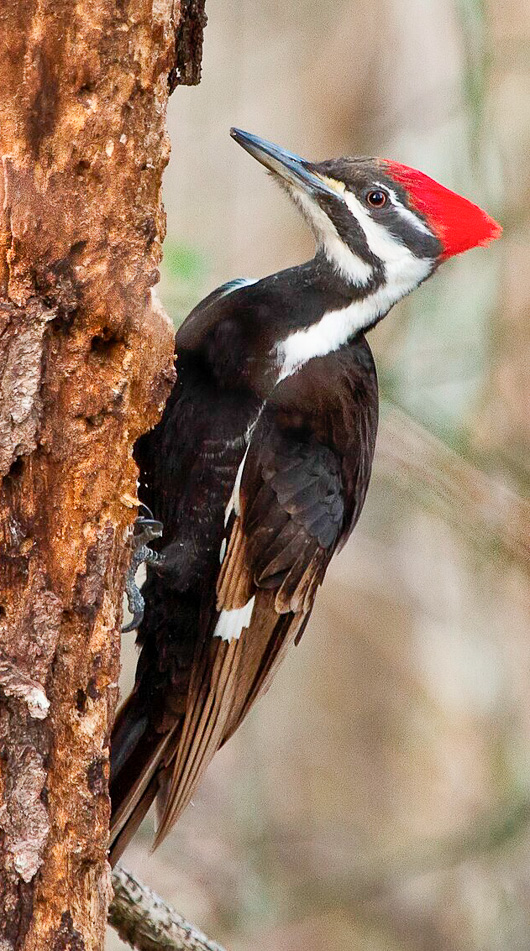
Pileated Woodpecker
The barred owl is roughly intermediate in size between the larger Ural and the smaller tawny owl, but the structural features of its relatively short and decurved claws more so resemble the tawny species as does their dietary and habitat ecology. The spotted owl has been hypothesized to be within a superspecies with the barred owl. However, genetic testing reveals very early divergence (likely at or near their ancestor's entry to North America) between spotted and barred owls.
The pileated woodpecker is a large, crow-sized woodpecker with a prominent red crest, white neck stripe, and a mostly black body. This woodpecker is native to North America, where it is the largest confirmed extant woodpecker species and the third-largest extant species of woodpecker in the world. It inhabits deciduous forests in eastern North America, the Great Lakes, the boreal forests of Canada, and parts of the Pacific Coast. This woodpecker is primarily an insectivore, eating insects that live in trees; it is famous for making large, nearly rectangular carvings into trees, which are used to extract prey inside the tree or to make a nest.
The species has a large range and an increasing population, causing it to be categorized as a species of least concern" by the IUCN in 2016.
Hylatomus pileatus